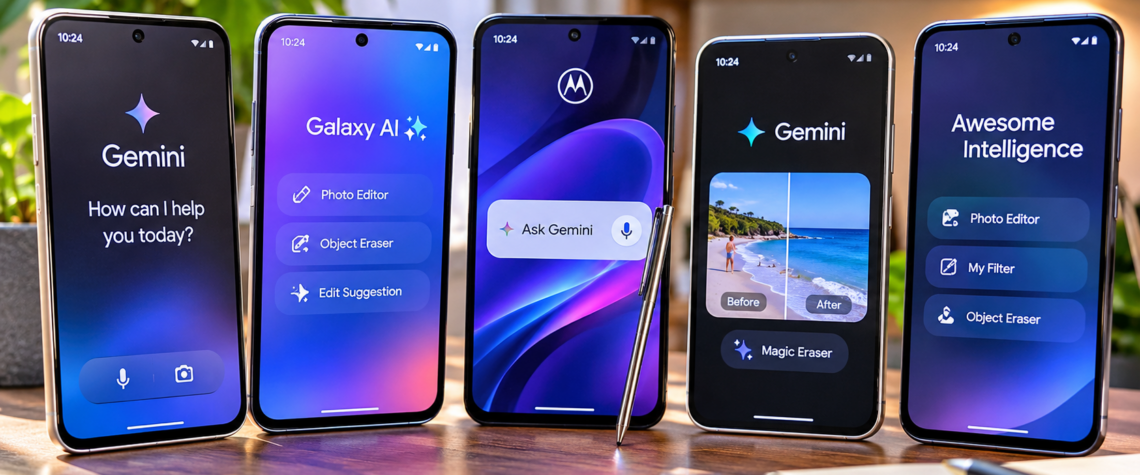
You don’t need a $1,000 flagship phone to use artificial intelligence. But not every affordable smartphone offers the same AI experience. We examine five alternatives and what consumers actually get for their money.
Artificial intelligence has become one of the smartphone industry’s favorite selling points. Manufacturers promise devices that can understand conversations, translate languages, improve photographs, summarize information, and anticipate what users need. Some of these features are genuinely useful. Others are little more than familiar software tools dressed up with a new AI label.
The good news is that consumers no longer need to buy the most expensive phones to experience many of these capabilities. Google’s Pixel A-series, Samsung’s Galaxy A-series, and Motorola’s Moto G lineup are bringing intelligent features to less expensive devices.
But there is a catch: the presence of an AI assistant does not necessarily mean a phone can perform advanced AI tasks locally, protect sensitive information from cloud processing, or offer the same features as its flagship counterparts.
For this comparison, AI Solutions Magazine examined manufacturer specifications, announced software capabilities, pricing, and independent assessments of five smartphones. We did not conduct hands-on laboratory tests, and our conclusions reflect the available evidence rather than original performance measurements.
1. Google Pixel 10a: The Strongest AI-Focused Contender
Google’s Pixel 10a makes a compelling case for consumers who want artificial intelligence integrated into everyday smartphone use.
Its capabilities include Gemini and Gemini Live, Circle to Search, Live Translate, Google’s call assistance tools, and AI-powered photography features such as Camera Coach, Magic Eraser, and conversational photo editing.
These features address practical needs. A traveler can use translation tools to communicate across languages. Someone receiving an unfamiliar call may benefit from call assistance. A photographer can remove distracting objects or adjust an image without learning professional editing software.
Google also promises seven years of operating system and security updates, an important consideration for anyone who wants to keep a phone rather than replace it every two or three years.
There are compromises. The Pixel 10a uses Google’s Tensor G4 processor rather than the newer chip found in some premium Pixel devices. Its 8GB of RAM also limits how much advanced AI processing it can handle locally. Some AI operations depend on Google’s cloud services, meaning privacy, connectivity, and feature availability deserve attention.
The Pixel 10a is not the cheapest phone in this comparison. But for readers whose main priority is a broad collection of integrated AI tools, it is the most persuasive candidate.
2. Samsung Galaxy A37 5G: Practical Intelligence at a Lower Price
Samsung’s Galaxy A37 5G approaches AI from a somewhat different direction. Rather than trying to reproduce every advanced Galaxy flagship feature, it focuses on accessible tools that make common tasks easier.
Samsung’s Awesome Intelligence package includes Object Eraser, Edit Suggestion, and My Filter. These tools help users improve photographs, remove unwanted elements, and apply personalized visual styles.
The A37 also offers a large 6.7-inch AMOLED display, a 50-megapixel main camera, and a 5,000mAh battery. Samsung promises six generations of operating system upgrades and six years of security updates.
Its principal limitation is the depth of its AI ecosystem. Buyers should not assume that every Galaxy AI feature advertised for Samsung’s expensive Galaxy S models is available on the A37.
For consumers who mainly want a reliable smartphone with useful photographic intelligence, rather than the broadest collection of AI features, the A37 is an attractive alternative.
3. Motorola Moto G Stylus 2026: AI Meets a Digital Pen
Motorola offers a different proposition with the Moto G Stylus 2026: a smartphone that combines AI assistance with an integrated active stylus.
The pen supports handwriting, drawing, annotation, and precise selection. Motorola also provides access to Gemini, Circle to Search, and productivity features designed around the stylus.
This combination could be particularly useful for students, professionals reviewing documents, and people who prefer handwritten notes to typing.
The trade-off is software longevity. Independent comparisons report two years of major operating system upgrades and three years of security updates, substantially less than Google and Samsung promise for their competing models.
That matters because AI features evolve quickly. A phone with shorter software support may become less attractive long before its hardware stops functioning.
The Moto G Stylus is worth considering for readers who will genuinely use the pen. For those who will not, its distinctive feature may offer little additional value.
4. Google Pixel 9a: Last Year’s AI Phone May Be This Year’s Bargain
The Pixel 9a remains relevant because the newer Pixel 10a is an incremental upgrade rather than a complete redesign.
Both devices share Google’s Tensor G4 platform, and the older model already offers many of the AI features that make Pixel phones appealing.
That creates an opportunity for bargain hunters. If the Pixel 9a is available at a substantial discount, it may deliver much of the same practical AI experience for less money.
However, buyers should compare the precise software features available on each model, the remaining update period, warranty coverage, and the condition of any refurbished unit.
A previous-generation smartphone can be a smart purchase, but only when the savings justify what the buyer gives up.
5. Samsung Galaxy A57 5G: A More Expensive Middle Ground
Samsung’s Galaxy A57 5G occupies a higher position in the company’s midrange lineup. It offers a refined design, a large AMOLED display, enhanced photographic capabilities, and Samsung’s Awesome Intelligence tools. Like the A37, it benefits from a long software-support commitment.
But its higher price creates a difficult question: does the extra money buy meaningfully better AI?
For users who mainly need assistance with photographs, searches, and ordinary productivity, the answer may not be obvious. A more expensive processor, thinner design, or upgraded camera does not automatically translate into a substantially more useful AI experience.
The A57 may appeal to buyers who value its overall hardware package. Consumers interested primarily in AI should compare its actual available features with those of the less expensive A37 and Google’s Pixel 10a before paying more.
What Does “Best AI” Really Mean?
An effective smartphone comparison should look beyond the number of features advertised.
Everyday usefulness. Can the phone summarize information, translate conversations, identify objects, help write messages, or improve photographs without complicated setup?
Accuracy. Does the assistant provide dependable information, and does it acknowledge uncertainty? AI-generated answers can still be wrong, regardless of the phone’s price.
Privacy. Which tasks are performed on the device, and which send information to remote servers? Users should understand what happens to photographs, recordings, and personal information.
Cost. Are the advertised AI features included with the phone, or do some require subscriptions? Are premium capabilities available only for a promotional period?
Longevity. Will the manufacturer continue delivering security patches and software improvements? A cheap phone with poor support may become an expensive mistake.
Accessibility. Can people use AI through ordinary speech, including languages other than English? Do translation, transcription, and voice-assistance features work reliably for the people who need them?
These questions matter more than marketing labels such as “AI-powered” or “intelligent.”
The Verdict: Google Leads in AI Breadth, Samsung Competes on Value
Based on the documented features and available independent reviews, the Google Pixel 10a is our leading choice for consumers who prioritize a broad, integrated AI experience in a relatively affordable smartphone.
Samsung’s Galaxy A37 5G offers a more economical approach, particularly for users interested in photo editing, a large display, and long-term software support.
Motorola’s Moto G Stylus 2026 stands apart for its combination of AI tools and pen-based productivity, although its shorter update commitment is a significant disadvantage.
The Pixel 9a deserves consideration when discounted, while Samsung’s Galaxy A57 is harder to justify solely on the basis of AI features.
None of these phones should be confused with a fully independent artificial intelligence system. Many of their most sophisticated functions depend on internet connectivity, remote computing, or services controlled by the manufacturer.
For consumers, the most important question is not which smartphone has the most AI branding. It is which one uses artificial intelligence to make everyday life genuinely easier—and whether that improvement is worth the price.
Editor’s note: This is a research-based comparison, not a hands-on product test. Prices, AI features, subscription requirements, and software availability may vary by retailer, region, language, and date. AI Solutions Magazine has not received review units or compensation from the manufacturers discussed.
Sources
- Google Store — Pixel 10a official technical specifications and AI features.
- Samsung Newsroom — Galaxy A37 5G and A57 5G launch specifications, pricing, and software support.
- Samsung — Galaxy A37 5G product information and Awesome Intelligence features.
- TechRadar — Best Cheap Phones 2026 and Pixel 10a assessment.
- Android Central — Pixel 10a versus Galaxy A37 and Moto G Stylus 2026 comparisons.